Well, a long while ago, I got the idea into my head that I would create a force of Movie Space Marines. That’s a joke list GW made in White Dwarf #300 where ten marines and a rhino were a 1500 point army. And they’re all tougher than Rambo.
So I decided would create a tactical squad that took as much time and effort to create as your average Warhammer 40,000 force did.
I got through them at quite a pace for a while, but soon other projects started getting in the way (most notably, my entries for the P3 Grandmasters). So, just like a real force, they’ve been put off and delayed.
Well, after such a long time away, they’re back. Somehow, I decided to paint them up before my new Malifaux crew or my Blood Bowl team. I’ve finished one more, and I only have a couple of the original Movie Marines left to paint.
So, here is the latest:
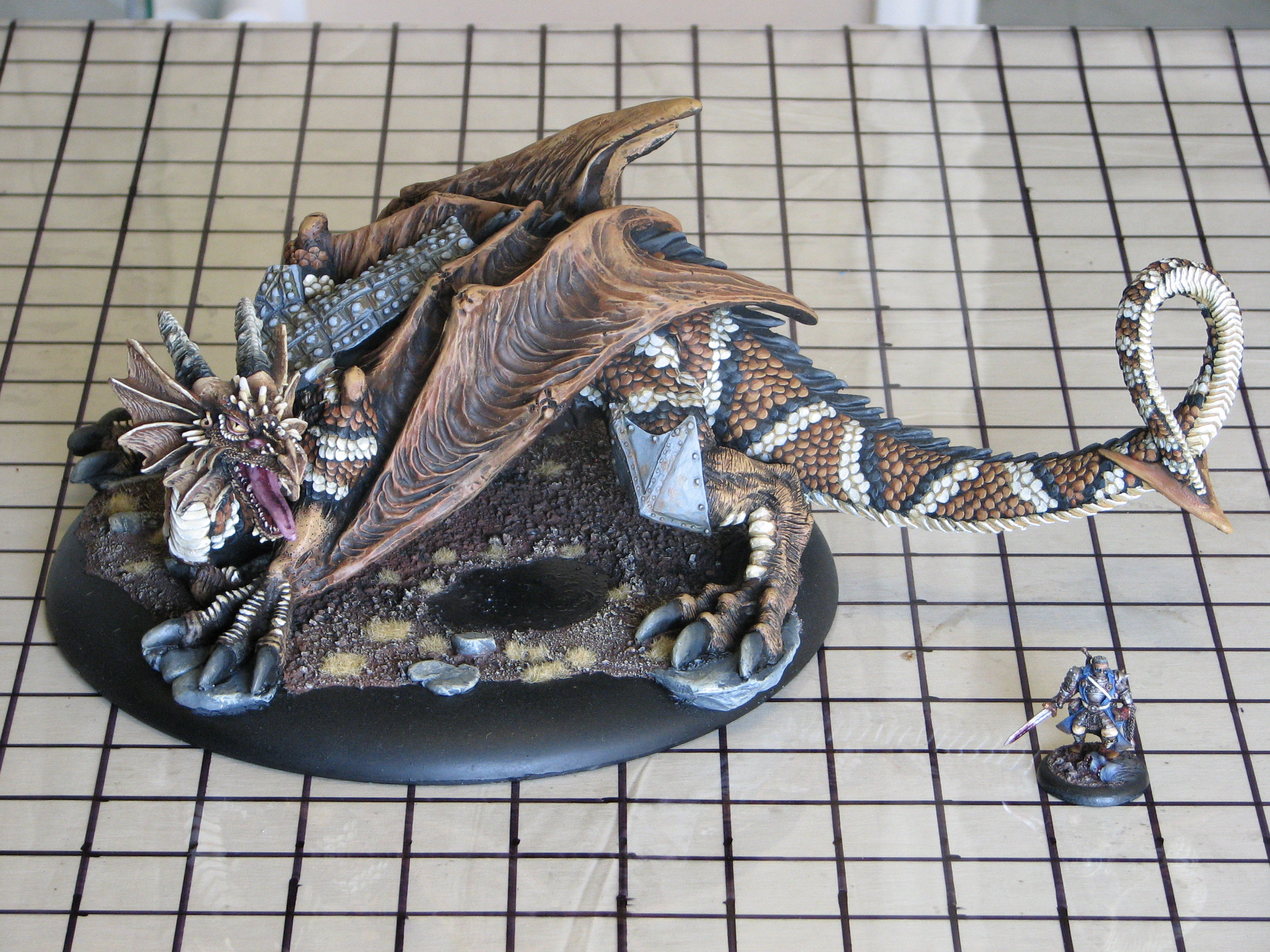
I had a number of requests for pictures of my dragon that show his scale.
So, here he is next to Professor Viktor Pendrake. Pendrake is on a 30mm base.
Our gaming table has 30mm squares all over it (because we usually play with minis whose bases are just slightly too large for the standard 1 inch squares).
Ever since I can remember, I’ve pretty much been responsible for making miniatures for any role playing groups that I’ve been in. Mostly, because I’m the only one who thought that we needed matching miniatures for our characters.
Right now I’m taking my turn GMing our Iron Kingdoms game. I decided to make it a super epic level campaign in which the party goes after all of those godlike beyond epic monsters that they always had to avoid in our other campaigns.
That means Dragons. Now, if you’re familiar with the Iron Kingdoms setting, you’ll know that there are no dragons smaller than Colossal size in all of the IK. When I started looking for minis, I was at a bit of a loss.
I could get a huge resin dragon for somewhere between two and five hundred dollars. It would fit the bill, but that’s pretty expensive.
I could pick up one of the discontinued Wizards of the Coast Colossal Red Dragons, but they’ve been going for two hundred dollars each, and are way less interesting minis than the resin ones for the same price.
I’m so glad that my wife pointed out a third option. For around twenty to thirty dollars, you can go to an Asian gifts store and pick up one of their dust collectors.
Now these minis tend to be a little less detailed than pewter or resin minis, and the pre-paints on them tend to be horrific. Whatever you do, don’t pick one up that has glitter all over it.
But with a little love, you can turn them into great looking minis. I have a second one in my back room waiting, but here is the first one that I’ve finished:
In the end, he looks like a pretty good, and massive sized mini.
I had to do a little bit of green stuff work on him. His horns were made of rubber and needed to be re-sculpted in something that could be painted, and his eyes had pupils sculpted onto them, which I thought would look better painted on.
His base was made from half of a super cheap Wal-Mart clock, and on our game board takes up just the right number of squares for a beyond epic level massive dragon.
I first became interested in wargamming when I was much younger. I was a little intimidated by Warhammer 40,000 because all you could buy was the book. I knew I wanted to play the game, but I also knew that the rules didn’t come with any minis, so it seemed like an incomplete game to me.
I finally decided that I could pick the game up when Games Workshop announced that they were releasing a “Boxed Edition” of 40k. I still think it is strange that no one called it the 2nd ed back then, and honestly I was a little surprised that the rules were so different from the Rogue Trader.
Anyway, shortly after that, Games Workshop started up their codex system of updating force lists, and the first two they did were the Space Wolves and Eldar.
And in those books, we had some of the first special characters for 40k. Before them, there was Commissar Yarrik and Ghazkull Thrakka, but those two codecies made it standard.
Also, a lot of the Space Wolf special characters have never had a mini update (unlike Thrakka and Yarrik). Some of the Eldar characters could probably use an update (Jane Zarr still has the most incredible mullet). I think the most impressive one is Eldrad Ulthuan.
For a while, Eldrad was the standard mini you’d use for a farseer. GW had released a non-character farseer mini, but it was so inferior to this one that everyone just assumed they’d use this. The practice spread even more widely when GW made the special characters illegal in competitive play, but allowed the minis to represent your non-special characters.
Anyway, I got to paint up some of the old characters recently. Eldrad here followed the same color scheme that we first saw back in the 2nd ed Eldar codex. Here he is:
There’s been a bit of hubub surrounding Monsterpocalypse lately. After the release of the Voltron two player game over the summer, it seems they haven’t slowed down. They have two player starter sets designed to look like the Voltron set (you get two random monsters from different factions, and a set of minions from the same faction).
What with the film that might actually get made (it has progressed from the “who knows” stage to the “pretty likely” stage) there’s been a lot of hubub.
But what I’m excited about are the minis. While their pre-paints aren’t always the best, Monpoc has released a good number of wonderful minis for repainting.
They’ve just posted up a bunch of new greens for us to have a look.
By the way, there’s something odd about that page. In the description, it sounds as though Privateer Press is working with the movie people to create some of the new Monpoc stuff.
That makes me wonder if we’re going to actually get miniatures based off of Tim Burton artwork. Makes me wonder.
While I was at Gencon, one sculptor asked me whether I knew where to find the very best faces on any range of miniatures. My first thoughts went to Dark Sword and their fantastic line of non-heroic scaled miniatures (the faces and hands are all so delicately detailed).
He told me that the best line was Tom Meier’s Thunderbolt Mountain line. At the time, I decided that I hadn’t seen enough of TBM to decide if he knew what he was talking about.
I can’t say that he was right, but it turns out that he wasn’t wrong. Tom Meier sculpted around half of the Dark Sword miniatures line.
With that, I’ll introduce to you all a recent commission for a Dark Sword piece. This one was sculpted by Jeff Grace (another of the best sculptors out there). The colors were largely a choice of my client in this case (he sent me some drawings to match). I think she turned out rather well.
My wife started playing Warmachine a while ago. It turns out that she really loves the undead in all varieties, so her choice to play Cryx was easy.
I remember talking to her about choosing colors for the force, and she pulled out this crazy bright orange and teal and said that she thought the undead should be brightly colored. She actually might have gone with pink if painting Warmachine minis in pink weren’t such an institutionalized practice.
Fast forward a little, she has a brilliant looking brightly colored undead force that has started looking like Cryx to me. So, I had to pull out my books when I was commissioned to paint a few minis up in the Privateer Press studio colors.
Overall, the Bane brown/grey color scheme fits well with my style- I like the neutral pallets. So here they are, Cryx in Brown instead or bright orange:
Ok, I have seen a lot of odd minis in my time. Miniatures sculptors, like all artists, are an odd bunch and really like to push away from what is standard and what is normal.
When they do, we get some pretty outstanding miniatures. Like Dark Age’s Contradiction, Yannik Hannebo’s Beauty and the Bot, or Kev White’s series of Libby miniatures. Great artistic renderings, all of them. Also, these are very strange minis.
But Emanuele Giovagnoni has presented to us one of the strangest concepts I’ve ever seen for a miniture. Here is “Grace is Gone” or the pregnant cyborg:
Beautiful sculpting work gave her this delicate pose that combines like eerily well with the Giger style tubes and metal plates.
But I’ll say it again: this is the strangest concept ever. By the way, you can get her from the Cool Mini store if you like strange. I know I do.
Yes, all of you Blood Bowl fans out there should know the Impact Miniatures line pretty well. For the past decade or so, they’ve been doing more for Blood Bowl than Games Workshop, and by quite a long shot.
They do have their own game (called Elfball) which they support pretty well, but they also have no qualms about doing a little bit of everything.
They’ve just unveiled the beginnings of a new elven team: the Timberline elves. So far, they’re looking pretty good. Sculpted by Patrick Keith, I think these go to show just how much he’s been improving. I can’t wait to see the rest of the team show up.
I have to say, I’ve been very impressed by the way that Fantasy Flight has treated their license to create Warhammer 40,000 role playing games.
From the brilliant artwork and the tone of each of the books, you really do get a strong feel for the rich universe of 40k- and it is honestly more rich and worked out in the RPG books than it is in most of the 40k force books.
One interesting note, though, is that there isn’t exactly a line of Dark Heresy or Rogue Trader minis. Deathwatch has plenty, since marines are the iconic centerpiece of 40k, but there are so few women, and even fewer non-military humans that finding good minis for a 40k RPG often takes you outside the line.
Dark Age has a good line of minis in trenchcoats, and a lot of them would work brilliantly as Rogue Trader characters. Another place to look is Reaper’s Chronoscope line, where pretty much anything goes.
Here is a character I painted for a Rogue Trader campaign. She originally came from Anima Tactics, but she has so much character that she was just screaming to be role played:
The guys over at Project Good have been working on a miniatures game system that incorporates every miniature you could possibly own.
It would seem that your two foot tall Vizeralyn the Oracle Dragon mini can go up against your Epic 40,000 imperial guardsmen. According to the rulebook, you can even use rocks or fruit if you are sad and don’t have minis.
Anyway, as part of their beta testing, they put the full rulebook up online for you to download. You can play and give them feedback to help them create a better game, or you can just play.
When I first started painting miniatures, I had a hard time with color recipes. Early on, I found an issue of White Dwarf with some of the old ‘Eavy Metal tutorials in it (mostly from Mike McVey). It was a huge help, and got my painting on track, but it also limited me quite a bit.
For example, I found a tutorial that gave me the color recipe for Khorne Red armor (a dark red, highlighted to a lighter red and then an orange). Well, that was my red, and it was my only red for quite a while.
I’ve come a long way since then, and I’m quite a bit beyond making my own recipes. One of the things I’ve learned is that you don’t always need to stick to even similar colors when you’re shading and highlighting.
For example:
This mini has quite a bit of different shading to her. Although the white armor was done pretty strait forwardly (it has just a little bit of blue in its shading) the rest of the mini was shaded in a dark magenta.
You can see it a little in her face, her green belt or on her grey sleeves, but there’s just a bit of a dark magenta beneath those colors. The red creates an interesting warm pallet even with colors that are not normally very warm.
Here’s a more extreme example:
I used a fairly standard human flesh tone for this Satyr’s skin, but I shaded it with several different colors. Parts of him are shaded with green, parts are shaded with purple, and other parts with red.
It is also easy to see the red shading in the loin cloth color, which is highlighted up to a light blue-grey color.
The highlighting has the same variety to it. Some parts are highlighted with lighter flesh tones, but some are highlighted in blue.
Actual objects in nature often have coloring this dynamic to them. For example, the coloring we see on a face is going to be a combination of pigments, blood and anatomy under the surface and the light- both from your lightbulb and a little coming in the window. All of these things are different colors, and there’s a lot of complexity to it.
Go ahead and experiment to see what happens when you shade your red with a green or if you highlight your grey with a pink, or if you shade your ork’s flesh with a red color. You may find you like the results.
Just a little while ago, I got a nice commission to paint an Eldar Avatar. I’ve painted a few different Avatars over time, this one is based a little more on the studio color scheme than previous ones that I’ve done.
The trouble with the Avatar mini is that he can very easily become too gaudy. His lower body really demands a lava glow effect while his upper body is adorned with all kinds of ornaments and detailed armor plates. If you choose a too bright color for the mane or tabard, it can get out of control.
For this mini, I used a darker color on his mane, and balanced the white tabard with a white rune on the Avatar’s head. Overall, I think it has worked pretty well, without really deviating from the studio scheme.
A little while ago I received a commission to convert and paint some themed chimeras for a Praetorian Imperial Guard force.
One was meant to be the chimera for an Ogryn unit. This one shows battle damage from the inside, since the Ogryn, it seems, are afraid of the dark. You can't see it quite as well from this photo, but the back door also shows signs of abuse:
The second chimera is for the psyker squad. Rather than show the extra battle damage, this chimera is covered with scrolls, purity seals, rune plates, a few books and even a couple of eyes.
I'm still not sure if those embellishments are meant to protect the psykers from warp energies, or if they're there to protect the rest of the guardsmen from the psykers.
Object source lighting (normally called OSL) is a pretty impressive technique that isn't too difficult to pull off. With OSL technique, you are trying to create the illusion that the mini is actually being lit by something on the mini rather than being lit from above. While there are several ways to do a strong OSL mini, each one gives you a different kind of light interplay.
The most straight forward OSL type is the strong, colored light. With this technique, you are trying to simulate a mini that is surrounded by darkness, with only one source of light- and that light source creates all of the color on your mini.
You need very few colors for this type of mini, and you will essentially be painting your mini in greyscale. It is sometimes best to only use two colors on a mini like this (black and the light's color). However, I prefer to use at least three colors (black, white and the color of the light) . That way, it is easy to have a very saturated color of the light without making the mini itself seem too dark.
Your color for your light source should be the lightest thing on the mini (I generally use a mix that is close to white- even for colored lights). The base coat for everything else is black.
After that, you need to highlight up toward the source of the light. For this, think of light as a particle rather than a wave. It only travels in straight lines, so take a straight tool (your brush will work) and try to draw straight lines from your light source to other parts of the mini. If you can't get a straight, unobstructed line from the light source to a certain spot on the mini, then that spot is in the shadow.
From there, the highlighting technique isn't very different from normal highlighting except that rather than highlighting towards the top of the mini (representing light from above) you are highlighting towards the source of your light. It sometimes helps to turn the mini sideways with the light source at the top so that highlighting in this way can feel more natural. Make sure that your highlights get lighter as they approach the source of the light.
When highlighting, you'll want to make sure that nothing is as light as your light source. That is an important part of the illusion you're creating. The source of light has to be lighter than the things that it is lighting, or else the eye won't be fooled into thinking that he's looking at an actual light source.
After you've done the more simple version of this with fewer colors, you might want to try out the same technique with more color. Try adding some color to the base colors on the mini (so that the flesh, metal and cloth are all a little different in color. You'll notice I did a little of this with the infernal above (his face has just a hint of purple to it).
But with the diorama below, I used quite a few different colors, and several sources of light (including moonlight coming from outside of the mini). The armor, flesh, cloth, rock and the hydra all have different base colors that were mixed into the highlighting (and all of them were highlighted toward the yellow light from the candles.
Also, since I used multiple sources of light on this mini, you'll notice quite a bit of different shadow interplay. It looks far more complicated than it is- I still used simple straight lines starting at the source of the light and highlights that got lighter as they approached the light source.
Overall, this is a technique that looks far more difficult than it is. Don't be too intimidated to try it out, you may find you're very pleased with the results.
Ok, so this is one of those commissions that I have to share. A client of mine created one of the coolest reposes for the Dire Troll Mauler that I've ever seen, and had me paint it up for him.
The colors are based on an example mini that he painted (there was a little room for interpretation). Overall, I thought this mini was a fantastic one to paint.
Just to make sure I'm giving credit where credit is due, I did not convert this mini, my client did. I only did a little bit of green stuff work in small places.
Victoria Lamb is a wonderful miniatures painter, and if you aren't already familiar with her work, you probably should go and have a look.
Ok, done there? The news is that she's just set up shop to sell her own line of miniatures. She's only just put up her store, so she doesn't have a lot of different minis yet. But the ones she has look pretty neat.
I'm particularly partial to the goblinoid fairies.
Welcome to Garden Ninja Studios, the source for your miniature painting and sculpting needs. We are currently accepting commissions. Please check out our forum and gallery and email us about your project. Watch here for photos of our recent studio projects, links to painting tutorials and other cool stuff.